Here’s a quick rundown of the used car loan requirements in Dubai: most residents with a steady income and valid Emirates ID can qualify for a used car loan as long as the car you’re buying is valued at AED 25,000 or more.
You’ll typically need to put down at least 20-30% of the car’s value, and your credit score should ideally sit above 650 for decent approval odds. The exact numbers vary by bank — here’s how it all breaks down.
Banks in the UAE generally look for the same core things: UAE residency, a stable income, and a car that meets their minimum value and age requirements.
On the income side, requirements vary more than you’d expect. Some banks accept salaries starting around AED 3,000-5,000, while others, especially for used cars specifically, set the bar closer to AED 8,000 or higher. If you’re self-employed, expect banks to look at your average bank balance instead, usually somewhere around AED 20,000-25,000, along with your trade license.
Most lenders also want to see 3-6 months of employment history in the UAE, with your salary paid into a local bank account. A fresh arrival with a brand-new job may need to wait a little before applying.
On the car’s side, most banks won’t finance a vehicle valued under about AED 25,000. There’s also usually a combined age limit: the car’s age plus your loan term typically can’t exceed 8-10 years, though this depends on the bank and the specific model.
Credit Score Requirements
Your credit score plays a bigger role than most first-time buyers expect. In the UAE, credit scores are tracked by Al Etihad Credit Bureau (AECB) on a scale from 300 to 900.
Here’s roughly how banks tend to read that number:
Below 400 — your application likely won’t even move forward
Below 600-620 — expect a higher chance of rejection, or approval with less favorable terms
650-680 — generally considered a solid, “good” score
700+ — this is where you’ll see the best interest rates and smoothest approvals
Now that you know the credit score needed for a car loan, you can check your own score through the DubaiNow app if you’re not sure where you stand. A basic Credit Score costs AED 10.50, or AED 84 for the full Credit Report with score included. It’s worth doing this before you start shopping, not after a rejection.
Documents You’ll Need to Apply
Whichever bank you go with, the paperwork list looks fairly similar:
Passport with valid UAE residence visa
Emirates ID
UAE driving license
Salary certificate
Bank statements (usually 3-6 months)
Trade license, if you’re self-employed
Having these ready before you start comparing offers can shave days off the approval process.
Down Payment Rules for Used Cars
Under UAE Central Bank regulation, banks can finance up to 80% of a new car’s value, meaning a 20% down payment minimum. For used cars, though, many banks lower that loan-to-value ratio to around 70%, pushing the minimum down payment closer to 30%.
Now, about those “0% down payment” ads you’ve probably seen. The 20-30% rule isn’t something banks can simply waive, it’s a regulatory floor. What actually happens is that the dealer or platform covers that gap themselves, usually by folding it into a higher loan amount, a slightly inflated car price, or bundled extras like insurance and service packages. The bank’s 80% loan-to-value limit stays exactly the same behind the scenes — you’re just not seeing the down payment as a separate line item.
That’s not necessarily a bad deal, it just means it’s worth reading the full breakdown before assuming “0% down” means zero cost.
Loan Terms and Interest Rates
Car loans in the UAE typically max out at 60 months (5 years). Beyond the interest rate itself, it’s worth checking whether a bank quotes a flat rate or a reducing (APR) rate, the two aren’t directly comparable at face value, and a lower-looking flat rate can end up costing more than a higher reducing rate. Always ask for the APR when comparing offers side by side.
Debt-to-Income Limit
Regardless of how much a bank might be willing to lend you, UAE Central Bank rules cap your total monthly debt payments — car loan, personal loan, credit cards, everything combined — at 50% of your gross income. This is the same Debt Burden Ratio (DBR) rule that applies across all consumer lending in the UAE, not something specific to car loans.
Car Loan vs. Personal Loan: How Ownership Works
Some buyers finance a used car through a personal loan instead of a dedicated car loan, and the two work quite differently, not just in terms of interest rates.
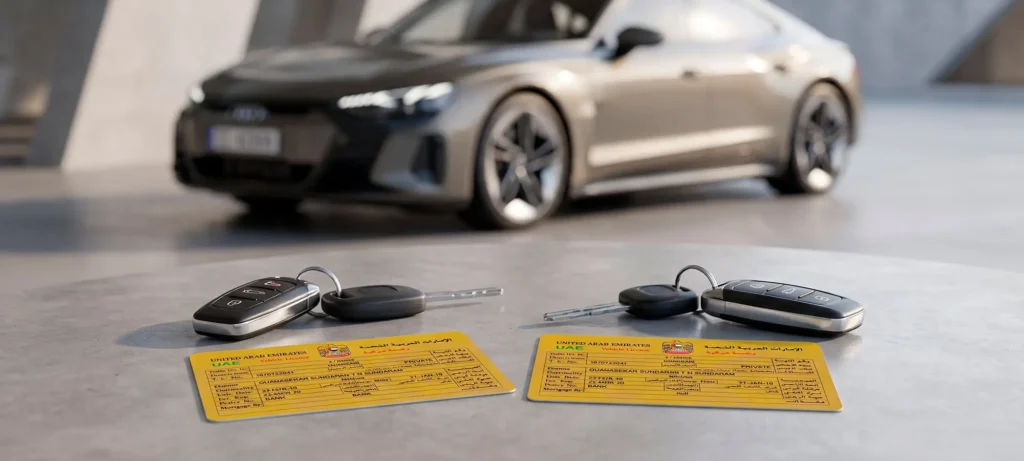
With a car loan (a secured loan), the bank registers itself against the vehicle. On your Mulkiya (the car’s registration card), you’ll see the bank listed under the “Mortgage By” field for as long as the loan is active. This means you can’t sell, transfer ownership, or export the car until the loan is fully paid off and the bank releases that mortgage.
With a personal loan, the “Mortgage By” field stays empty from day one — the loan has no legal claim over the car itself. Approval is based purely on your income and credit profile rather than the car’s age or value, and the interest rate is typically higher to offset that lack of collateral.
Neither is objectively “better”, it depends on what you value more: a lower rate (car loan) or full, unrestricted ownership from day one (personal loan).
If you do go the car loan route, here’s what happens once you make your final payment: the bank updates RTA’s system electronically, usually within 1-3 business days, and you’ll get an SMS or email confirming the release, no physical paperwork needed. There are still government fees to release the mortgage from your file:
Fee
Amount
New Ownership Certificate
AED 50
Ownership Amendment
AED 100
Knowledge and Innovation Fee
AED 20
Total
AED 170
(That AED 20 Knowledge and Innovation Fee shows up in several different RTA transactions, by the way — it’s a standard government charge, not something specific to loan releases.) You can find the full breakdown directly on RTA’s mortgage release page.
Lease-to-Own: Another Financing Option
If a large down payment isn’t realistic for you right now, lease-to-own is worth knowing about as an alternative, though it’s a different arrangement, not technically a loan. A leasing company owns the car while you pay for the use of it, with an option to buy it outright at a pre-agreed residual value at the end of the term (typically 12-60 months).
Because this isn’t classified as a loan, the Central Bank’s down payment rules don’t apply, which is why some lease-to-own providers can offer low or even zero upfront payment. In exchange, mileage limits and total cost vary a lot between providers, so it’s worth comparing the full contract carefully rather than just the headline monthly figure.
How to Get Pre-Approved for a Used Car Loan
Before you start seriously browsing, it helps to know roughly what you can actually afford each month. Our free car loan calculator lets you plug in a car’s price, your down payment, and your preferred loan term to see an instant monthly estimate, a useful starting point before you approach a bank for formal pre-approval.
Frequently Asked Questions
Most banks look for a score of at least 650 for solid approval odds, with 700+ typically unlocking the best rates. You can check your score through the Dubai Now app for AED 10.50.
It ranges from around AED 3,000-5,000 at some banks up to AED 8,000+ at others, especially for used vehicles — it really does depend on the lender, so it’s worth checking with a few.
Not directly — UAE Central Bank rules require a minimum 20-30% down payment on car loans. “0% down payment” offers typically fold that cost into the loan amount or car price rather than removing it.
Your Emirates ID, passport with residence visa, UAE driving license, salary certificate, and 3-6 months of bank statements. Self-employed applicants also need a trade license.
Not until the bank releases its mortgage from your file with RTA — the car remains legally tied to the loan until then. If you’re planning to sell a car that still has an outstanding loan, that’s a whole process on its own, and we’ll cover it in detail in a separate guide.
[…] For a complete overview of credit score requirements, required documents, and what “0% down payment” offers actually mean, read our guide to Used Car Loan Requirements in Dubai. […]
Clear, practical answers for anyone buying, selling or driving a car in the UAE. From choosing between GCC and non-GCC cars to paying fines and keeping your car in shape in the heat.
Ready2Ride Motors offers a seamless used car buying experience in Dubai, with pre-inspected, accident-free vehicles and full transparency at every step. Explore our handpicked selection of GCC-spec cars and find your perfect ride today.