








Used Car Warranty UAE: 10 Facts Every Buyer Should Know (2026)
October 6, 2026
A seller hands you a warranty certificate and says relax, you’re covered. Here’s the uncomfortable truth. That piece...

Short answer: the most reliable way to learn how to check if a car is GCC spec is to read the compliance plate on the driver door frame. If it says the car complies with GSO regulations, the car is GCC spec. The language of the plate does not matter.
Most buyers do something else. They look at the Origin line on the Mulkiya or the first letter of the VIN, and walk away with the wrong idea.
At Ready2Ride Motors we read the plates and paperwork of our cars every day. The signs people trust most turn out to be the least reliable.
In this guide you will find:
Still deciding which spec to buy? Start with our guide to GCC vs American spec cars.
GCC spec means a car was approved for the Gulf markets under the rules of the GCC Standardization Organization (GSO).
According to GSO, it has verified and approved conformity certificates for new motor vehicles since 1 January 2005. An approved certificate is accepted in all GCC states.
That approval is a manufacturer matter. In our experience the Mulkiya does not state the regional spec, which is why knowing how to check if a car is GCC spec takes a few steps.
One more thing to know up front: a GCC car is not always a local UAE car. We explain the difference further down.
Open the driver door and look at the plate on the door frame. This is where the manufacturer states which rules the car was built to meet.
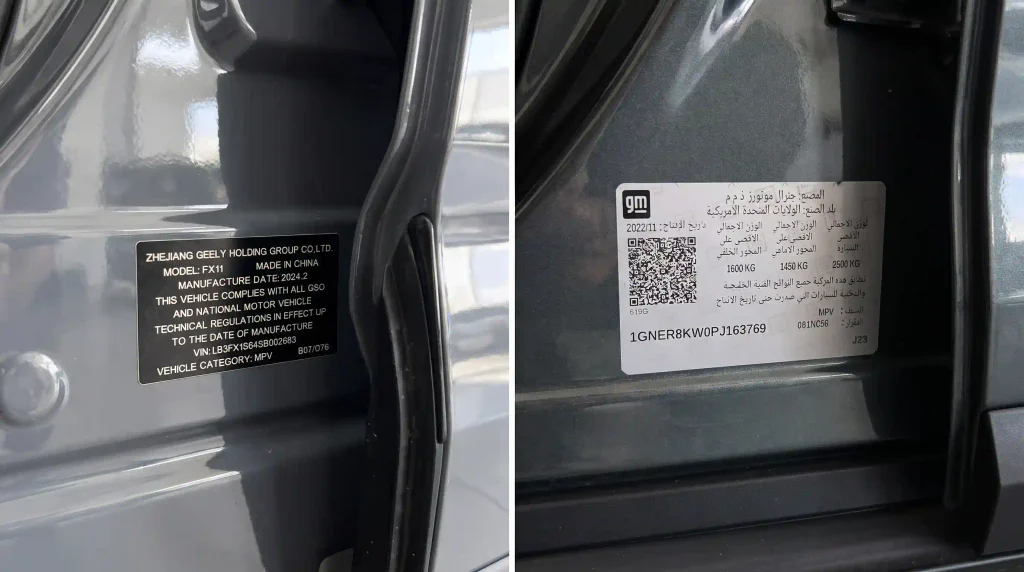
In our experience, a GCC car carries a compliance sentence on this plate. It says the vehicle complies with all GSO and national motor vehicle technical regulations in effect up to the date of manufacture. Our team confirmed this with a senior colleague who handles these cars every day, and we found the same sentence on the plates of our own cars.
Look for one of these two sentences:
In English:THIS VEHICLE COMPLIES WITH ALL GSO AND NATIONAL MOTOR VEHICLE TECHNICAL REGULATIONS IN EFFECT UP TO THE DATE OF MANUFACTURE
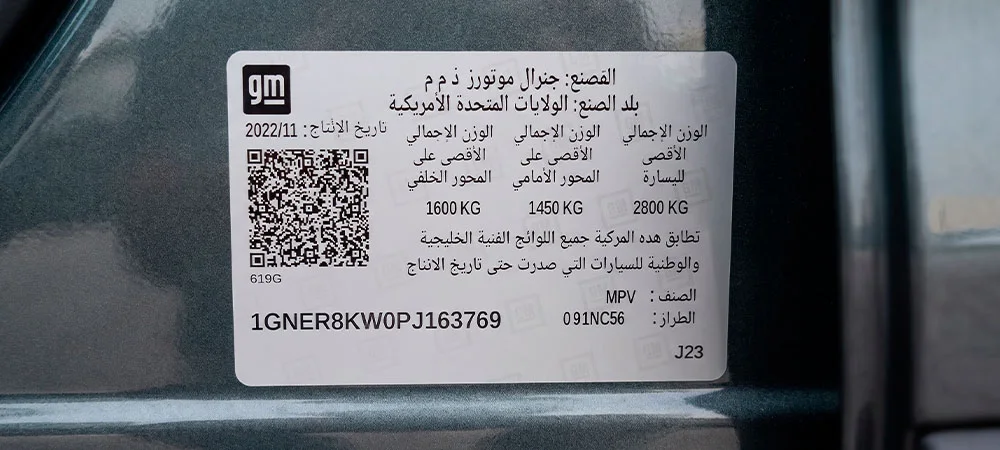
In Arabic, version 1:تطابق هذه المركبة جميع اللوائح الفنية الخليجية والوطنية للسيارات التي صدرت حتى تاريخ الانتاج
In Arabic, version 2:تطابق هذه المركبة جميع اللوائح الفنية الخليجية و التي صدرت حتى تاريخ الإنتاج
The Arabic wording differs a little from brand to brand, but the key words are the same: the Gulf technical regulations, and the date of manufacture.
The language of the plate does not matter. Some GCC cars on our lot have a plate fully in English, like our Geely and Volvo. Others are fully in Arabic, like our Chevrolet Traverse. What matters is the compliance sentence itself.
The plate also helps you spot a US spec car. A US plate has a different sentence. Under US federal rules, the certification label states that the vehicle conforms to all applicable Federal motor vehicle safety standards, and it sits on the driver door pillar.
If your plate talks about Federal standards and not GSO, it is not a GCC car.
What if the plate is missing, painted over or looks replaced? Do not guess. Use the report check below and ask the seller why.
Before we go through how to check if a car is GCC spec, let us clear up the signs that mislead people most often. Here is the quick overview:
| Sign | What it shows | How far to trust it |
|---|---|---|
| Compliance sentence on the door plate | The rules the car was built to meet | The sure sign, in any language |
| Origin on the Mulkiya | Where the car was built | Does not show the spec |
| First letter of the VIN | Usually the country of the maker or the plant | Does not show the spec |
| Engine number on the Mulkiya | Filled in for local UAE GCC cars | Blank does not mean non GCC |
| Arabic text on mirrors and plates | Often a car made for the Gulf | Helpful, but English text proves nothing |
| Red rear turn signals | The light design of the car | Weak clue |
| Speedometer in mph | A car made for the US market | Strong on analog clusters, weak on digital ones |
| Asking a dealer to check the VIN | Whatever that dealer has on record | Unreliable |
Now the details.
The most common mistake when learning how to check if a car is GCC spec is reading Origin as the spec. Origin only shows where the car was built.
In our experience, a GCC car built in the US shows United States as its origin. A local Toyota built in Thailand shows Thailand.
The GCC cars on our lot were built in the US, Germany, Slovakia, South Africa, Spain, Sweden, Italy and China. The Origin line is different on almost every one, yet the spec is the same.
Many UAE websites say that a VIN starting with W means the car is GCC spec. That is a myth.
The first character of a VIN usually matches the country where the car was built. For many European brands, though, it follows the country where the brand is based, as explained on Wikipedia.
Two examples from our lot:
A US spec Mercedes built in Germany starts with W too, so the letter cannot separate GCC cars from US spec cars. And cars built in the US start with 1, 4 or 5 and can still be fully GCC spec.
It sounds logical to ask the brand’s dealer to confirm a car from its VIN. In practice it is unreliable.
Some brands have separate dealers in different emirates. A dealer in one emirate may have no record at all of a car that another dealer supplied.
If a dealer cannot find your car, that proves nothing about its spec.
Arabic text on the side mirrors and on the door plate often points to a car made for the Gulf. In practice it is not reliable.
We checked the plates of the GCC cars on our lot:
Arabic text is also missing from the mirrors of many of our cars. So Arabic text is a helpful clue, but English text proves nothing. Read the compliance sentence instead.
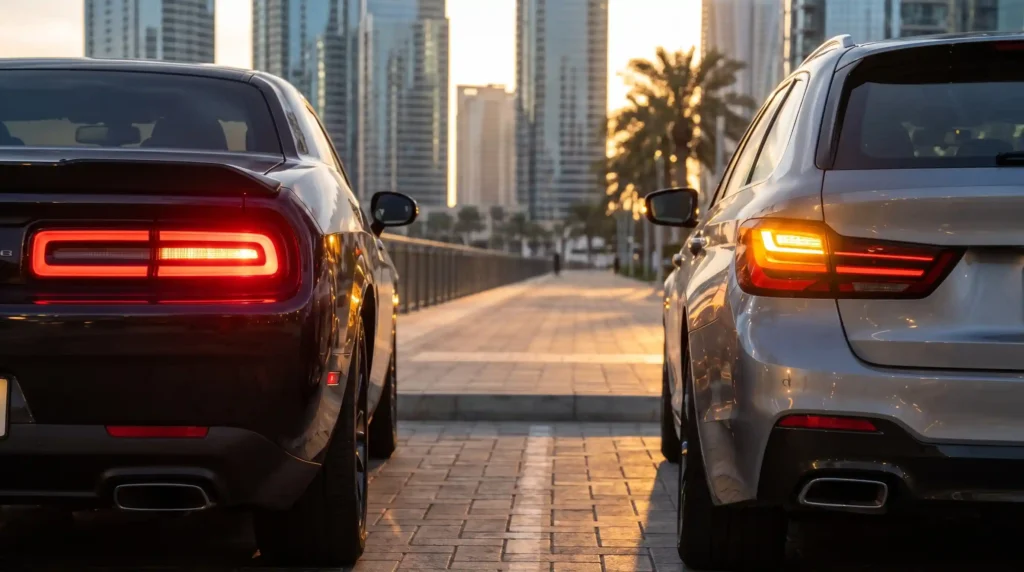
Many cars made for the US market have red rear turn signals, while European style cars have amber ones. This is a weak clue.
One of our colleagues drives a local Lincoln MKZ that is GCC and still has red turn signals. The car uses one red light strip, and the signals come from the same strip.
A car built in the US can be sold as GCC spec, so the color of the signal tells you very little.
Start with the door plate when you work out how to check if a car is GCC spec. Use the other checks to back it up, especially when the plate is missing or the seller’s story does not add up.
Open the driver door and read the plate. Look for the sentence about GSO and national motor vehicle technical regulations, in English or in Arabic.
Take a clear photo of the plate and the VIN on it, and keep it with your notes.
This is the check that answers how to check if a car is GCC spec better than any other.
Here is how to check if a car is GCC spec through the Mulkiya. In our experience, the engine number field is filled in only for local UAE cars that are GCC.
Cars that were imported, including GCC cars from Oman and other Gulf countries, usually have it blank, even though the spec is still GCC.
What this means for you:
If the field is blank on a car that is claimed to be local, ask the seller where the car came from, because it is most likely an import from another Gulf country.
Two reports can state the spec directly.
The RTA report. The RTA Technical Vehicle Status Report is for cars registered in Dubai. In our experience, its specification section includes a line that shows whether the car is GCC.
The seller must agree to share the data, and the report does not include accident history. The fee is 120 AED (checked on 31 October 2026), so confirm it on the RTA page before you apply.
The comprehensive inspection report. In our experience, the Tasjeel report states whether the car is GCC or non GCC. Reports can differ from center to center, so ask what the report includes before you book, and ask the seller for permission to take the car in.
A GCC car from any other Gulf country will also show as GCC on these reports, so they will not tell you if the car is local.
A car that was serviced at UAE agency dealers from the first kilometer, with the warranty active, is a strong sign of a local GCC car. The key words are from the first kilometer.
A single stamp or a few late services prove little. A US car can be brought to a UAE dealer for service and receive a local stamp.
So ask for the service book or the dealer record, and check that the history has no gaps.
Also look in the glove compartment. Many owners keep the original books there, such as an Arabic owner manual and warranty papers. Missing books prove nothing, but they mean you should rely more on the plate.
Our guide to the used car warranty in the UAE explains what to ask.

If an analog speedometer shows miles, the car is a US market car. Kilometers prove less, because a cluster can be replaced.
Be careful with digital clusters, especially on American brands like Dodge and Ford. These often let the driver switch between kilometers and miles, even on cars sold in the UAE.
If you see miles on a digital cluster, do not decide on that alone. Go back to the door plate.
Sometimes a car is GCC spec but was not supplied by a UAE dealer, and that changes how to check if a car is GCC spec and local.
We have bought cars as GCC that later turned out to come from another Gulf country, for example Oman. This happens because the same model, such as a Toyota, can cost less there, so buyers bring it to the UAE.
These cars are still GCC spec, and they are built for Gulf heat just like a local car. They are not US spec cars, which are not tuned for local conditions, as we explain in our GCC vs American spec guide.
The difference shows up in three places:
So when you ask how to check if a car is GCC spec, also ask whether it is a local car or an import from another Gulf country. The plate answers the first question. The engine number and service history help with the second.
Find the VIN in three places: on the dashboard plate under the windscreen, on the door plate and in the engine bay. All three must match the Mulkiya exactly.
Then run the VIN through the history checks in our guide to checking car history in the UAE.
For a used car that was imported, the Ministry of Industry and Advanced Technology offers a product status statement. It confirms the vehicle is eligible for registration in the UAE traffic system, and the ministry lists the fee as 0 AED (checked on 7 November 2026).
It is a compliance check, not a GCC label, so it does not tell you the spec.
If you cannot confirm the spec, do not rely on the Mulkiya alone. Instead:
A spec you cannot confirm can affect insurance, parts, warranty and resale, so it is worth settling before the deal. Knowing how to check if a car is GCC spec also means knowing when to stop and ask for an inspection.
If you would rather start with cars we have already checked, you can browse our cars. Found one you like? Estimate your monthly payment with our car loan calculator.
And if you are selling and want to prove the spec of your own car, gather the service book, the dealer invoice and the warranty papers first, then see how selling your car to us works.
The best answer on how to check if a car is GCC spec is to read the compliance sentence on the door plate, in any language, and then back it up with the engine number, a report and a full service history.
Origin and the VIN letter tell you about the build, not the spec.
And remember that a GCC car can be a local car or an import from another Gulf country, which changes the warranty more than the spec.
Read the plate on the driver door frame. A GCC car carries a sentence saying the vehicle complies with all GSO and national motor vehicle technical regulations, in English or in Arabic. Then back it up with the engine number on the Mulkiya, an RTA or Tasjeel report and a full service history from day one.
No. The compliance sentence about GSO and national motor vehicle technical regulations can be fully in English, fully in Arabic or partly in both. What matters is the sentence itself, not the language.
No. The first character of a VIN usually matches the country where the car was built, but for many European brands it follows the country where the brand is based. A German brand built in Slovakia or South Africa can still start with W, and cars built in the US can be GCC spec.
No. Origin on the Mulkiya shows where the car was built. A GCC car built in the US shows United States as its origin and is still GCC spec.
No. In our experience, the engine number is filled in only for local UAE cars that are GCC. GCC cars imported from other Gulf countries, such as Oman or Saudi Arabia, usually have it blank but are still GCC spec. Confirm the spec with the door plate.
The spec is the same and the car is built for Gulf heat, but it counts as an import. The warranty from the local UAE dealer usually does not apply, and the trim or engine can differ. Some dealers can cover or extend the warranty, so ask before you buy.
Often they do. In our experience, the RTA Technical Vehicle Status Report for Dubai registered cars and the comprehensive inspection report from Tasjeel both state whether the car is GCC. A GCC car from another Gulf country also shows as GCC, so the report does not tell you if the car is local.
Yes. Several GCC cars on our lot were built in the US. Where a car was built and which regional spec it has are two different things.


